

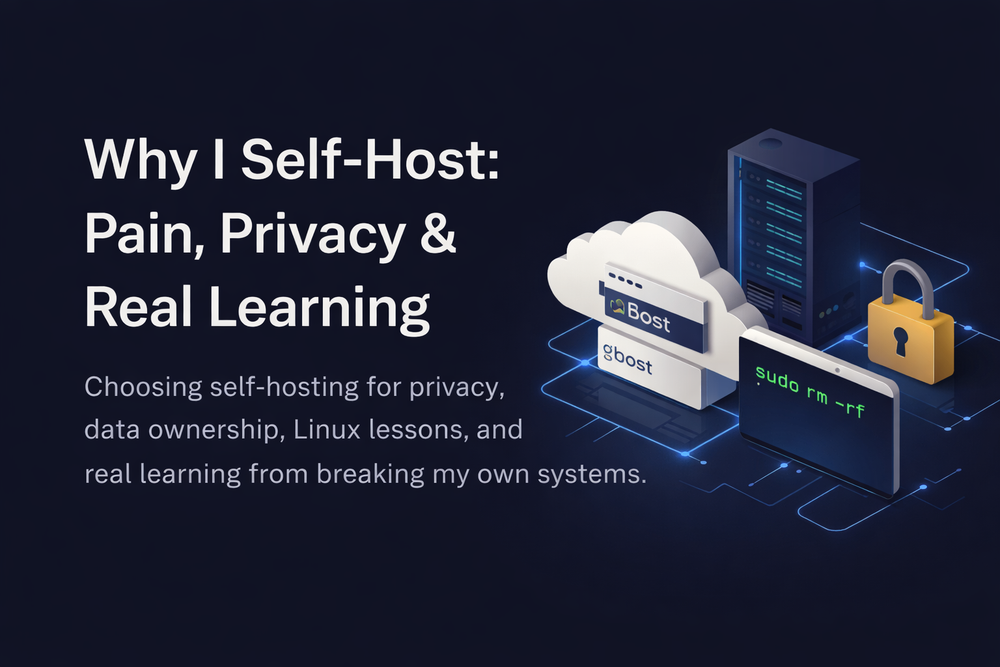
Why I Self-Host: Because I Enjoy Pain (and Privacy)
Introduction
In a world where “the cloud” is really just someone else’s computer, I decided I wanted my own computer to keep me awake at night.
Welcome to my blog.
Here, I write about self-hosting, troubleshooting, and the many creative ways I’ve accidentally deleted my entire database while trying to “optimize” it.
1. Data Ownership
(Or: No More “Surprise” Subscription Hikes)
I self-host because I have trust issues.
With big SaaS platforms, you’re always one policy update or pricing change away from losing control of your own data. When I self-host tools like Ghost or Nextcloud, the data is mine.
If something breaks or disappears, it’s my fault — and honestly, that’s weirdly comforting.
2. Troubleshooting: The Ultimate Detective Game
Self-hosting is:
- 10% configuration
- 90% staring at a terminal wondering why a Docker container is screaming at you.
Some highlights from the chaos:
- The Logs
Reading logs feels like a mystery novel where the villain is always a missing semicolon. - Standardizing Chaos
Trying to make API responses look professional while the backend is held together with duct tape and hope. - The “It Worked on My Machine” Curse
Moving code from my laptop to a VPS is the bravest thing I do all week.
3. Learning by Breaking Stuff
They say you don’t truly know Linux until you’ve accidentally run:
sudo rm -rf something-important
Self-hosting has taught me more about Linux, networking, security, and DevOps than any ₹40,000 certification ever could.
And as a bonus, it gives me a socially acceptable excuse to say:
“I’ll be there in 5 minutes — I’m just redeploying.”
Self-hosting isn’t easy.
It’s frustrating, painful, and occasionally terrifying.
But it’s also freedom, control, and the fastest way to truly understand how the internet actually works.
And yes… I’d still do it again.